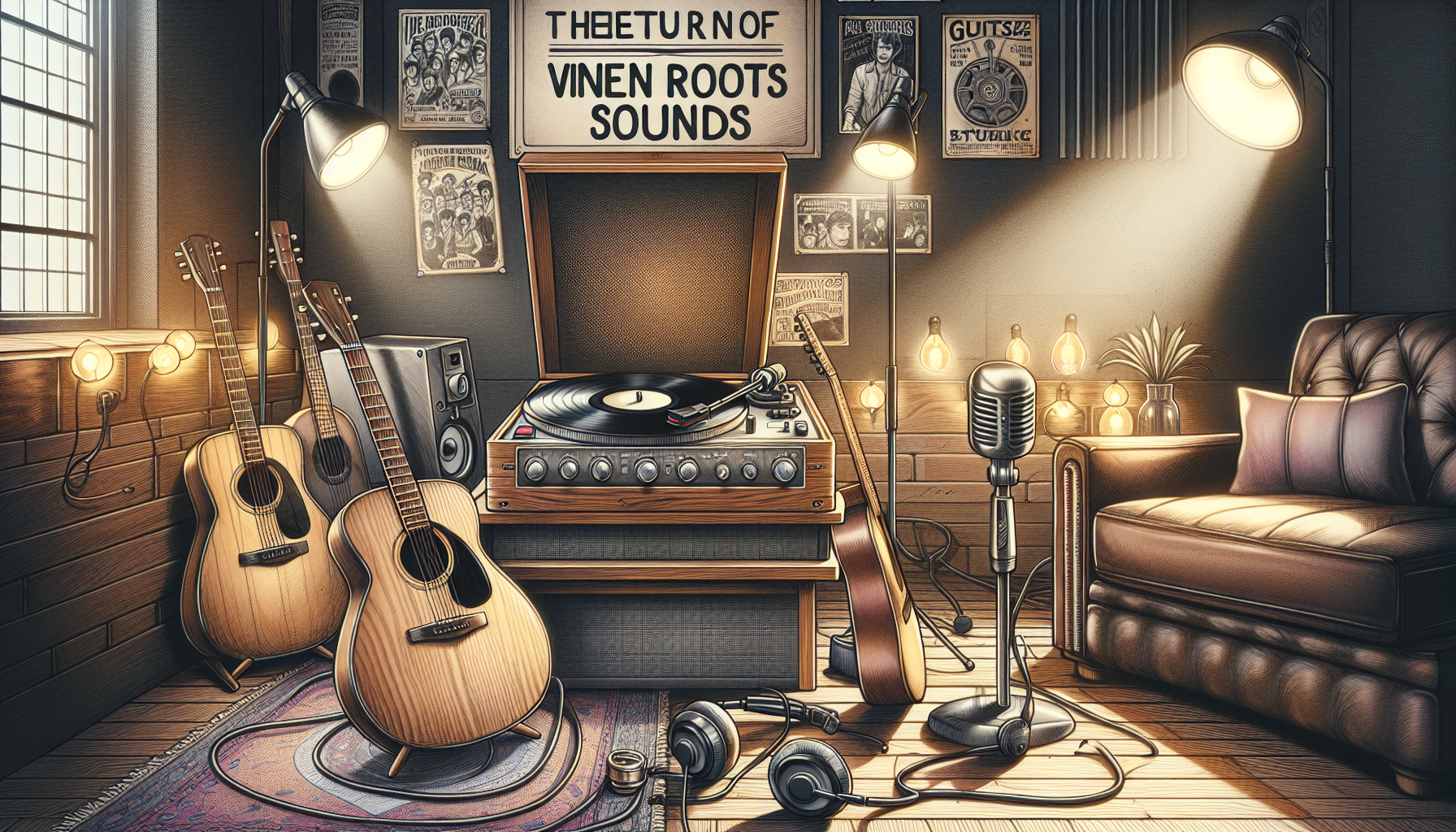
There is something almost rebellious about dropping a needle onto a record in an era defined by streaming algorithms and digital playlists. Yet across studios, living rooms, and independent record shops from Nashville to Amsterdam, a growing community of musicians and listeners is doing exactly that — and doing it with fierce intention. The acoustic renaissance is not a nostalgic accident. It is a deliberate, passionate reclamation of warmth, imperfection, and human connection in music. Vinyl records and analog sound are not simply surviving in the modern roots scene — they are actively dominating it.
The Return of the Record: More Than a Trend
For years, industry analysts dismissed vinyl’s comeback as a passing fad — something Gen X nostalgics and hipsters clung to while the rest of the world moved toward convenience. Those analysts were wrong. According to the Recording Industry Association of America (RIAA), vinyl LP revenue has outpaced CD sales for multiple consecutive years. In 2023 alone, vinyl accounted for over $1.2 billion in U.S. music revenue. Independent record stores reported record-breaking sales on Record Store Day events, and major artists across genres began releasing not just vinyl editions, but vinyl-first editions.
Within the roots music world — encompassing folk, Americana, bluegrass, country blues, and alt-country — this resurgence is particularly profound. These genres were born in analog environments. Their spiritual DNA lives in tape hiss, room ambience, and the natural resonance of acoustic instruments. When roots artists choose vinyl and analog recording, they are not chasing a gimmick. They are coming home.
Why Analog Sound Speaks to Roots Music
To understand the dominance of analog in the modern roots scene, you need to understand what analog actually does to sound — and what digital often strips away.
Analog recording captures sound as a continuous electrical signal, preserving all the tiny fluctuations, overtones, and micro-dynamics that live in acoustic instruments and human voices. When a guitarist fingers a chord on a vintage Martin or a fiddler draws a bow across steel strings, the resulting sound is layered with complexity: breath, wood resonance, string noise, room reflection. Analog tape and vinyl capture this complexity faithfully. Digital recording, particularly at lower bit rates or with heavy compression, tends to flatten these nuances into something cleaner but colder.
Roots music listeners — and the artists who serve them — have always been extraordinarily sensitive to these differences. The genre’s aesthetic is built on authenticity, rawness, and emotional directness. When you hear a voice crack on a high note or a guitar string buzz slightly against a fret, those imperfections communicate humanity. They tell you that a real person, in a real room, felt something deeply enough to record it. Digital perfection can sometimes erase that message entirely.
The Role of Harmonic Distortion
One of the key sonic characteristics of analog equipment — particularly tube amplifiers, tape machines, and vinyl playback — is the generation of harmonic distortion. Unlike the harsh, unpleasant digital clipping distortion, analog harmonic distortion tends to consist of even-order harmonics that the human ear perceives as warmth, richness, and depth. This is why old recordings on analog tape sound “full” even at low volumes, and why many listeners describe vinyl playback as feeling “alive” in a way that streaming cannot replicate.
For roots musicians working with acoustic instruments, this harmonic character is not a flaw to be corrected — it is a feature to be embraced. It enhances the natural tonality of banjos, upright basses, acoustic guitars, and fiddles in ways that modern digital signal chains often struggle to emulate convincingly, despite the best efforts of plugin developers.
The Studios Leading the Analog Revival
A quiet but powerful network of recording studios has emerged as the backbone of the acoustic renaissance. These are spaces that have either preserved their vintage analog equipment or deliberately invested in restoring it. They operate with Neve and API consoles, Studer and Ampex tape machines, and microphone collections that include vintage RCA ribbons, Neumann U47s, and AKG C12s.
- Blackbird Studio (Nashville, TN) — One of the largest and most respected analog-capable studios in the world, beloved by Americana and country artists for its collection of vintage outboard gear and exceptional tracking rooms.
- Muscle Shoals Sound Studio (Sheffield, AL) — A legendary facility whose analog heritage is inseparable from American roots music history, continuously attracting artists who want to record where the ghosts of soul and country still linger.
- Sonic Ranch (Tornillo, TX) — A destination studio in the Texas desert that combines world-class analog equipment with an immersive, distraction-free environment ideal for roots artists seeking deep creative focus.
- United Recording (Los Angeles, CA) — A historic facility with connections to Frank Sinatra and countless classic recordings, now serving a new generation of folk and singer-songwriter artists drawn to its legendary live rooms.
Beyond these established institutions, a growing number of small, independent “bedroom” and “barn” studios are operating entirely on analog signal chains — a democratization made possible by the declining cost of vintage equipment on secondary markets and the passionate advocacy of audio engineers committed to preserving analog craft.
Artists Who Are Championing the Analog Cause
The modern roots scene is populated with artists who have made analog recording and vinyl releases a central part of their artistic identity. Their reasons are as varied as their sounds, but their commitment is consistent.
Gillian Welch and David Rawlings have long been emblematic of analog devotion, recording in ways that prioritize live performance feels and natural room sound. Their releases carry an intimacy that listeners consistently describe as transportive — as if you are sitting in the same room where the music was made.
Sierra Ferrell, whose debut record on Rounder swept through the Americana world like a revelation, was tracked with careful attention to analog warmth. Her voice and her vintage-inflected string arrangements benefit enormously from the tonal generosity of tape and vinyl.
Tyler Childers has spoken openly about his appreciation for the sound of classic country records and his desire to capture something of that quality in his own work — an aspiration his producers have honored with thoughtful analog-influenced production choices.
Across the Atlantic, the UK and European folk revival scenes have similarly embraced analog. Artists like Sam Lee and Lisa O’Neill record in ways that honor the acoustic and human qualities of traditional material, often choosing intimate live-to-tape approaches that digital workflows would complicate unnecessarily.
Vinyl as a Cultural Statement
Choosing to release music on vinyl in 2024 is not just an aesthetic decision — it is a cultural and philosophical statement. It says something about how an artist values their music and how they want it to be experienced.
Vinyl demands attention. You cannot shuffle a record. You cannot skip tracks without physical effort. The album as a complete artistic statement — with its sequencing, its artwork, its liner notes — is honored and preserved by the vinyl format in a way that streaming playlists do not even attempt to replicate. For roots artists who tend to think deeply about the narrative arc of an album, this is enormously meaningful.
There is also a community dimension to vinyl culture that resonates powerfully with the communal values embedded in roots music traditions. Record fairs, listening parties, record store browsing — these are shared, social experiences. They mirror the barn dances, front-porch sessions, and community sings from which so much roots music originally emerged.
The Technical Craft of Cutting Vinyl
Not all vinyl is equal, and serious roots artists and their labels invest significant attention in the technical process of translating a recording to lacquer and pressing it properly. The mastering process for vinyl is a distinct art form, requiring mastering engineers who understand the physical limitations and tonal characteristics of the medium.
Bass frequencies must be carefully managed to prevent groove modulation issues. High frequencies must be handled with sensitivity to avoid sibilance distortion on playback. The dynamic range of acoustic instruments — which can swing dramatically between pianissimo and fortissimo — must be balanced in ways that honor the original performance while ensuring the needle tracks the groove reliably.
Leading mastering engineers like Bob Ludwig, Greg Calbi, and Pete Lyman have deep expertise in this specialized craft. Artists who invest in skilled vinyl mastering are rewarded with pressings that genuinely outperform their digital counterparts in warmth, presence, and emotional impact — particularly when played back through quality analog equipment.
What This Means for the Future of Roots Music
The acoustic renaissance and the dominance of vinyl and analog sound in the modern roots scene represent something larger than a production trend. They represent a values system — a collective insistence that music should feel like something, that it should carry the physical and emotional traces of human making, and that the listener’s experience deserves more than convenience.
As digital fatigue grows among listeners who have spent years consuming algorithmically curated content through earbuds, the tactile, warm, imperfect world of vinyl and analog is not just appealing — it is necessary. It provides a counterpoint to the frictionless, frictionless homogeneity of streaming culture.
For roots music — which has always been about real people, real places, real emotion, and real craft — analog and vinyl are not relics. They are the most honest, most faithful tools available for communicating what this music has always been trying to say.
The renaissance is not coming. It is already here. And it sounds absolutely beautiful.