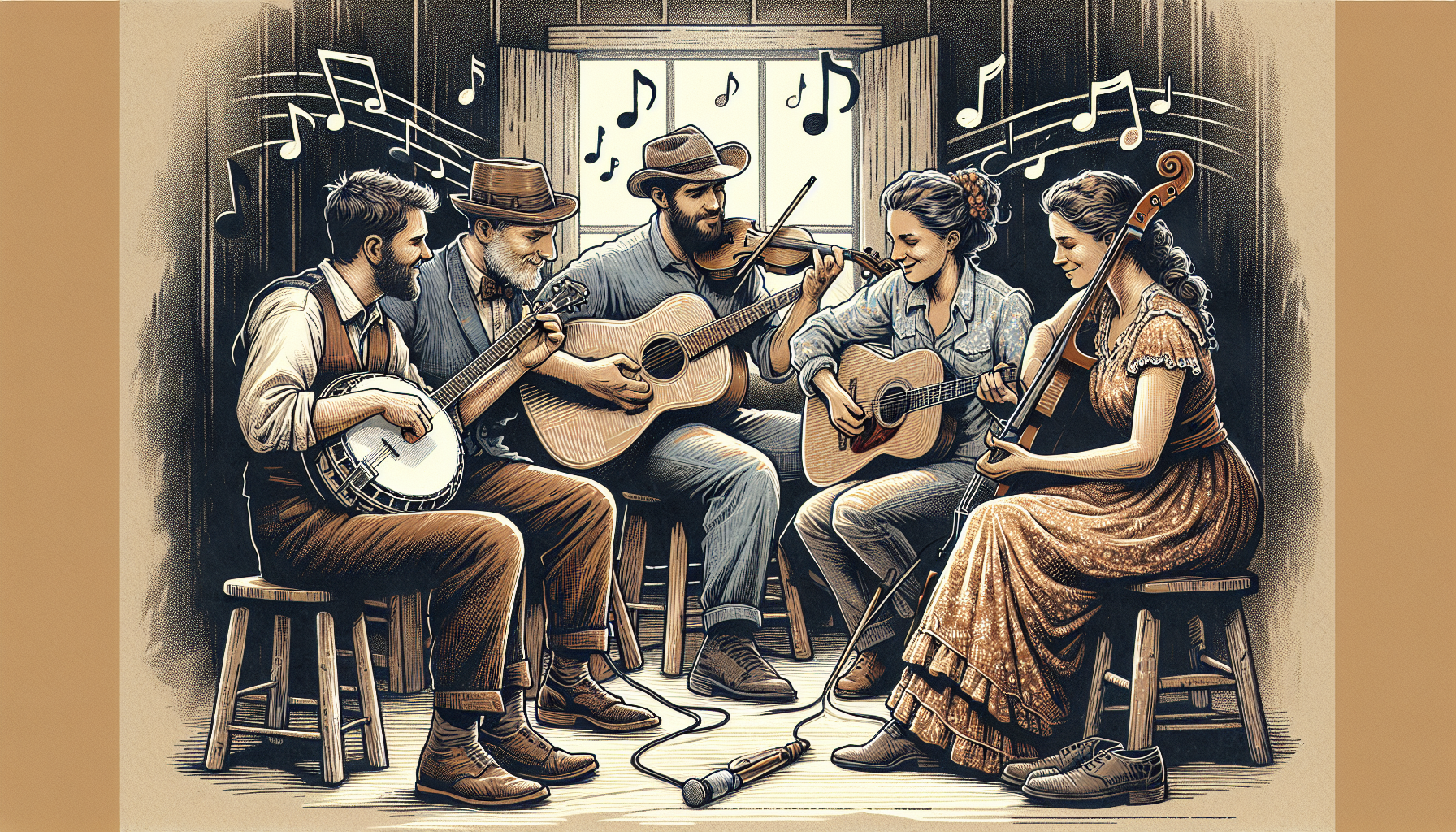
Long before streaming platforms and algorithm-driven playlists, there was a simpler, more profound form of musical communication — a man or woman with a guitar, a fiddle, or a banjo, standing before a crowd and spinning a yarn that could make you laugh, weep, or feel a deep pang of recognition in your chest. Bluegrass and country music have always been more than just genres. They are living archives of the American experience, built on a bedrock of narrative tradition that stretches back centuries. These are the songs of ordinary people living extraordinary lives, told with an honesty and depth that few other musical forms can match.
The Roots of Narrative Song: Where the Stories Began
To understand why bluegrass and country music are such powerful storytelling vehicles, you need to look at where they came from. The earliest seeds of these genres were planted in the Appalachian Mountains of the American Southeast, carried there by Scots-Irish immigrants in the 17th and 18th centuries. These settlers brought with them a rich tradition of ballad singing — long, detailed narrative songs that told stories of love, betrayal, murder, tragedy, and redemption.
Traditional ballads like Barbara Allen and Tom Dooley were not just entertainment. They were oral history. In communities where literacy was limited and newspapers were scarce, songs served as a communal memory system. A skilled ballad singer was a historian, a journalist, a moral guide, and an entertainer all at once. This multi-layered role became embedded in the DNA of what would eventually evolve into bluegrass and country music.
The African American musical traditions — blues, gospel, and field hollers — also played an indispensable role in shaping the storytelling voice of these genres. The blues, in particular, introduced a raw, first-person confessional style that gave country and bluegrass their emotional directness. When these traditions merged in the rural South during the late 19th and early 20th centuries, something genuinely unique was born.
The Architecture of a Country Narrative
What makes a great country or bluegrass story-song? The best ones follow a structure that feels almost literary in its precision. There is typically a clear protagonist, a conflict — often involving love, loss, family, or hardship — and a resolution that carries emotional or moral weight. Unlike pop music, which often trades in vague feelings and universal platitudes, country and bluegrass songs tend to be hyper-specific. Names, places, and details matter enormously.
Consider the craft at work in a song like Jimmie Rodgers’ In the Jailhouse Now or Hank Williams’ Long Gone Lonesome Blues. These aren’t abstract meditations on sorrow — they are fully realized scenes, populated with specific characters making specific choices. The listener doesn’t just feel sad; they understand exactly why the character is sad, who wronged them, and what the consequences were.
- Character specificity: Great story-songs introduce characters with distinct personalities and motivations.
- Concrete imagery: Details like a dusty road, a broken-down truck, or a faded photograph ground the narrative in physical reality.
- Emotional arc: The best songs take the listener on a journey — from hope to despair, from anger to forgiveness, from confusion to clarity.
- Moral weight: Many of the greatest bluegrass and country narratives carry an implicit or explicit moral lesson without becoming preachy.
- Vernacular authenticity: The language feels real. It sounds like someone actually talking, not performing.
Hank Williams and the Golden Age of Country Storytelling
No discussion of narrative tradition in country music can proceed very far without arriving at the towering figure of Hank Williams. Born in Alabama in 1923, Williams had a gift for compression — the ability to pack an entire human drama into three minutes and a chorus. Songs like Your Cheatin’ Heart, I’m So Lonesome I Could Cry, and Lost Highway remain definitive examples of what a story-song can achieve when crafted by a genuine literary talent.
Williams understood instinctively that the best country stories are universal even when they are deeply personal. His own life — marked by poverty, alcoholism, failed marriages, and early death — fed directly into his music. But his genius lay in translating private pain into public poetry. When Hank Williams sang about loneliness, every person in the audience who had ever felt alone felt, paradoxically, less so.
This era — roughly the 1940s through the 1960s — is often called the golden age of country storytelling. Artists like Patsy Cline, Loretta Lynn, and George Jones were crafting narratives of staggering emotional complexity. Loretta Lynn, in particular, deserves recognition as one of the great social storytellers in American music history. Songs like Coal Miner’s Daughter, The Pill, and You Ain’t Woman Enough tackled poverty, women’s rights, and domestic conflict with a frankness that was genuinely radical for their time.
Bluegrass and the Mountain Ballad Tradition
While country music was finding its commercial footing in Nashville, bluegrass was developing its own distinct narrative voice in the mountains and hollers of Appalachia. Bill Monroe, the acknowledged father of bluegrass, and his Blue Grass Boys created a sound that was simultaneously ancient and modern — rooted in old-time mountain music but driven forward by an almost jazz-like improvisational energy.
Bluegrass narrative songs often deal with themes that feel lifted directly from the old ballad tradition: murder ballads, tragic love stories, religious redemption, and homesickness for a lost way of life. Songs like Little Maggie, Shady Grove, and Man of Constant Sorrow carry the same emotional DNA as the British ballads that colonists brought to America centuries earlier.
The Stanley Brothers — Carter and Ralph — represent perhaps the purest expression of bluegrass narrative tradition. Their recordings of mountain ballads and original gospel songs created a body of work that feels simultaneously timeless and deeply rooted in a specific place and culture. Carter Stanley’s voice, in particular, had a quality that seemed to channel something ancient and unnameable — a direct line back to the first storytellers who ever sat around a fire and began to sing.
The Modern Era: Keeping the Story Alive
As country music moved through the rhinestone glitter of the 1970s, the polished production of the 1980s, and the stadium-filling anthems of the 1990s, many critics worried that the storytelling tradition was being diluted. And in some corners of mainstream Nashville, they had a point. But the tradition never truly died — it simply found new voices.
Artists like Townes Van Zandt, Guy Clark, and Steve Earle kept the narrative flame burning through the outlaw country movement and beyond. Van Zandt’s Pancho and Lefty is a perfect example of modern country storytelling at its finest — a tale of outlaws, betrayal, and the passage of time that works equally well as a poem and as a song.
In bluegrass, artists like Alison Krauss, Gillian Welch, and the Punch Brothers have demonstrated that the genre’s storytelling capacity is not only intact but actively evolving. Gillian Welch, in particular, writes songs that feel like they could have existed for a hundred years — stories of Depression-era hardship, rural poverty, and quiet desperation that resonate just as powerfully in the 21st century as they would have in the 1930s.
Why These Stories Still Matter
In an age of information overload, when we are bombarded with data, news, and content from every direction, there is something profoundly necessary about a song that tells a story with clarity, honesty, and emotional truth. Bluegrass and country music, at their best, remind us that every life is a story worth telling — that the struggles of a coal miner’s daughter, a long-haul trucker, or a grieving widow are not lesser subjects than the grand themes of classical music or literary fiction.
These genres also preserve something increasingly rare in popular culture: the idea that a song should mean something beyond its surface sound. The best bluegrass and country narratives demand active listening. They reward attention. They ask you to care about characters who may live very different lives from your own, and in doing so, they quietly expand your capacity for empathy.
The storytelling tradition in bluegrass and country music is not a relic of the past. It is a living, breathing artistic practice that continues to produce work of genuine literary and emotional power. From the ancient Scottish ballads that crossed the Atlantic with immigrant settlers, to the porch songs of Appalachia, to the honky-tonk heartbreakers of Nashville, to the neo-traditional artists performing in small clubs and concert halls today, the thread of story runs unbroken through it all.
The Legacy That Keeps on Singing
Perhaps the most remarkable thing about the narrative tradition in bluegrass and country music is how faithfully it has been passed down through generations. Unlike many folk traditions that had to be consciously rescued by revival movements, these storytelling practices were simply never abandoned. Each generation of musicians learned them from the one before, absorbed them, and then found new ways to use them to speak to their own time and place.
The result is a tradition that is simultaneously ancient and contemporary, deeply local and universally human. When a young bluegrass musician picks up a banjo and begins to play a song about hard times and broken promises, they are connecting themselves to a chain of storytellers that stretches back across centuries and oceans. They are, in the most literal sense, keeping the story alive.
And as long as there are human beings who need to hear that their struggles are real, their loves are worth singing about, and their lives have meaning — there will be storytellers of song ready to take the stage and begin.