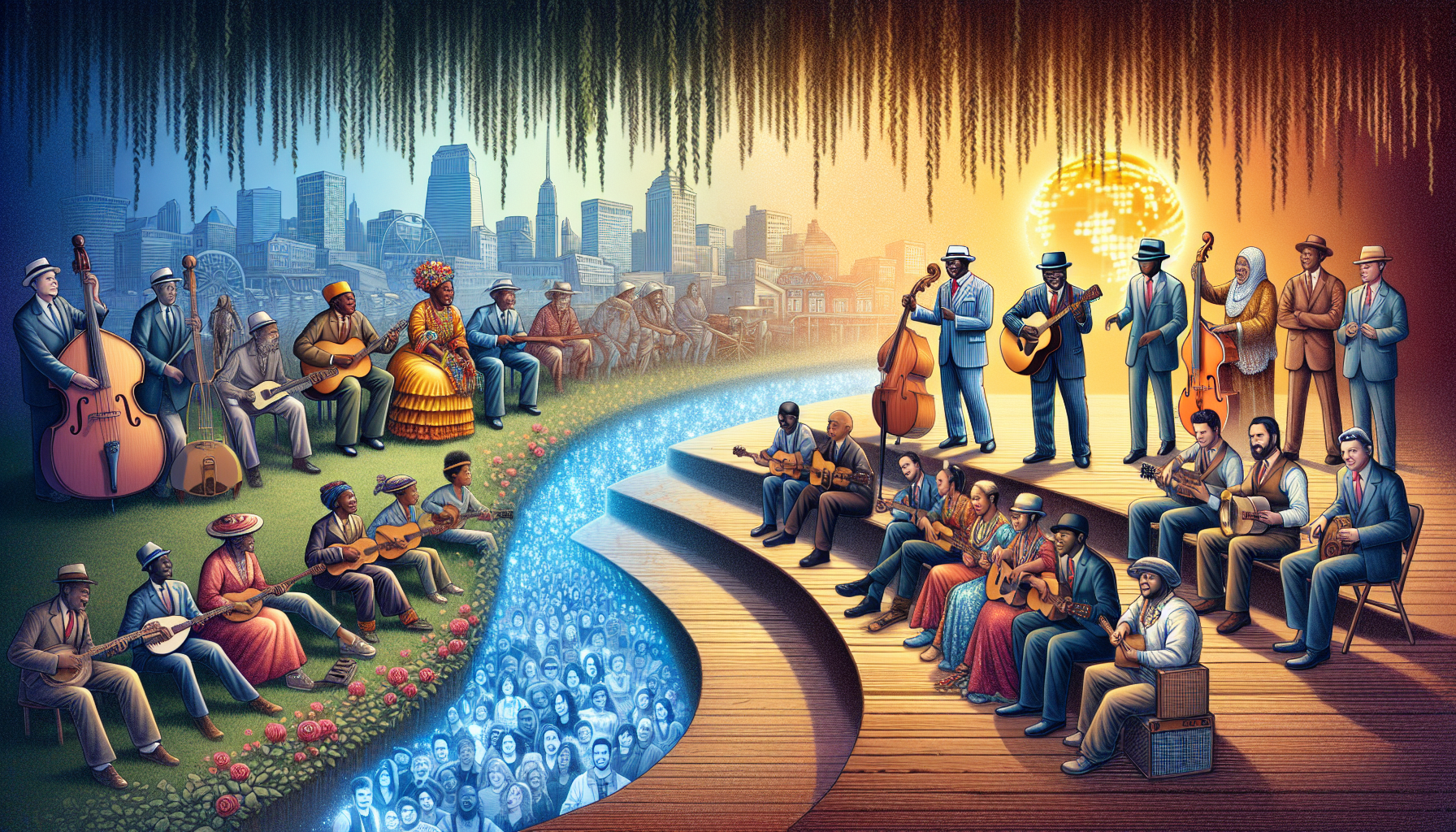
There is a moment in every great musical journey when something ancient and deeply personal transcends its origins and becomes universal. For the music born in the swampy lowlands of the Mississippi Delta, that moment came not once, but repeatedly — rippling outward across decades, continents, and genres, reshaping the sonic landscape of modern civilization. From the makeshift porches of sharecropper cabins to the thundering arenas of Tokyo, London, and São Paulo, Southern roots music has done what few cultural movements ever achieve: it has made the entire world feel the same feeling at the same time.
The Cradle of a Sound: Understanding the Delta
To truly appreciate how Southern roots music conquered the world, one must first understand where it came from — and why those origins matter so profoundly. The Mississippi Delta, a flat alluvial plain stretching between the Mississippi and Yazoo rivers, was one of the most economically brutal and culturally fertile places in American history. In the late 19th and early 20th centuries, African American workers toiling in cotton fields found in music a language that could carry what words alone could not: grief, longing, defiance, hope, and joy compressed into a single bent guitar string.
The blues — raw, modal, deeply emotional — was not merely a genre. It was a survival technology. Figures like Robert Johnson, Charley Patton, Son House, and Skip James encoded entire philosophies of endurance into their three-chord progressions and haunting vocal slides. The call-and-response structure, borrowed from African musical traditions and shaped by the realities of plantation life, created an intimate dialogue between performer and audience that no other musical form had quite captured in the same way.
The Great Migration and the Electrification of the Blues
Music does not stay still, and neither did the people who made it. The Great Migration of the early-to-mid 20th century carried hundreds of thousands of African Americans northward — to Chicago, Detroit, Cleveland, and beyond. With them traveled the blues, but the blues that arrived in the industrial cities was not the same blues that left the Delta. It was louder, more assertive, and it plugged into the electrical grid of urban ambition.
Chicago, in particular, became a second womb for the sound. Muddy Waters, Howlin’ Wolf, Little Walter, and Sonny Boy Williamson transformed acoustic intimacy into electric power. The amplified guitar wail and the harmonica’s piercing cry became the sound of post-war tension and aspiration. Chess Records, founded by the Chess brothers on South Michigan Avenue, became the unlikely launch pad for a sound that would eventually orbit the globe.
- Muddy Waters – Brought Delta guitar traditions into the electric age with raw authority
- Howlin’ Wolf – His theatrical growl and physical intensity set a template for rock performance
- Little Walter – Elevated the harmonica from folk instrument to lead voice
- Chuck Berry – Fused blues structure with narrative storytelling and showmanship
The British Invasion Was Actually a Southern Export
Here is one of popular music history’s most delicious ironies: the so-called “British Invasion” of the 1960s — that tidal wave of bands from England that seemed to overwhelm American pop culture — was in large part a repackaging and reimportation of American Southern roots music. The Rolling Stones took their name from a Muddy Waters song. The Beatles covered Chuck Berry obsessively in their early years. Led Zeppelin’s entire aesthetic architecture was built on the bones of Robert Johnson and Willie Dixon.
Young British musicians, many of them working-class kids in industrial cities not unlike Chicago, heard in Delta and electric blues a music that spoke directly to their own experiences of alienation and ambition. They studied it with academic devotion and performed it with volcanic passion. By doing so, they inadvertently introduced millions of white American teenagers to a music their own country had largely marginalized.
The global reach of these British bands — playing sold-out tours across Europe, America, Asia, and South America — meant that the musical DNA of a sharecropper singing on a Mississippi porch was now embedded in the consciousness of an entire planet’s youth culture.
Country, Gospel, and the Full Spectrum of Southern Sound
The blues was never the only instrument in Southern music’s orchestra. The full picture of roots music from the American South includes a rich tapestry of interconnected traditions, each with its own history and global impact.
Gospel and Sacred Music
The African American church was, in many ways, the emotional and structural laboratory where Southern music was refined. Gospel music’s emphasis on communal participation, vocal improvisation, and the direct expression of spiritual ecstasy fed directly into soul, R&B, and eventually pop music. Artists like Mahalia Jackson, Sister Rosetta Tharpe, and later Aretha Franklin carried the gospel tradition onto stages that reached every corner of the world. Tharpe, in particular, was performing guitar-driven gospel rock to stunned audiences in Britain as early as the 1940s — decades before anyone coined the term “rock and roll.”
Country and Appalachian Folk
Meanwhile, in the hills of Tennessee, Kentucky, and the Carolinas, a parallel roots tradition was evolving. Appalachian folk music, shaped by Scots-Irish immigrant traditions and blended with Native American and African influences, produced the banjo-driven, high-lonesome sound that became country music. The Carter Family and Jimmie Rodgers, recording in Bristol, Tennessee in 1927, created what historians call the “big bang” of country music — a moment as significant to roots music as any single event in jazz or blues history.
Country music’s global expansion has been extraordinary. Today, country artists regularly sell out venues in Australia, the United Kingdom, Germany, and Scandinavia. The themes of home, heartbreak, hard work, and redemption that define the genre apparently speak a universal emotional language.
Rock and Roll: The Synthesis That Changed Everything
If the blues was the spark and gospel was the flame, then rock and roll was the explosion. Born in the early 1950s at the crossroads of blues, gospel, country, and rhythm and blues, rock and roll was Southern roots music’s first fully global dialect. Sam Phillips at Sun Studio in Memphis understood this instinctively — he was looking for a white artist who could perform with the feeling of Black Southern music, and when a young truck driver named Elvis Presley walked through his door, the modern world lurched permanently in a new direction.
But Elvis was only one thread in a much larger tapestry. Little Richard’s screaming piano style, Jerry Lee Lewis’s honky-tonk fury, Fats Domino’s rolling New Orleans groove — all of these were Southern roots traditions refracted through individual genius and technological amplification. The results were felt in Berlin, Buenos Aires, Nairobi, and Seoul.
Contemporary Echoes: Southern Roots in the 21st Century
One might assume that in an age of digital production, algorithmic playlists, and global pop homogenization, the influence of Southern roots music would have diminished. The opposite appears to be true. If anything, the appetite for authenticity and emotional directness that roots music represents has only intensified as mainstream pop has grown more polished and synthetic.
- Americana and Alt-Country movements have created vibrant international communities of artists and fans who explicitly trace their lineage to Delta blues and Appalachian folk
- Blues festivals in Chicago, Memphis, and the Mississippi Delta itself continue to draw pilgrims from Japan, Germany, France, and beyond
- Hip-hop’s Southern chapter — from Atlanta trap to Houston chopped-and-screwed — carries the blues tradition’s spirit of making art from hardship
- Beyoncé’s “Lemonade” album explicitly drew on Delta blues imagery, demonstrating that the tradition remains alive in the most commercially successful corners of modern music
Artists like Gary Clark Jr., Brittany Howard, and Fantastic Negrito are proving that the blues voice is not a museum artifact but a living, breathing, evolving form. They perform to enthusiastic crowds on every continent, carrying forward a conversation that began more than a century ago in the most unlikely of places.
Why This Music Travels: The Secret of Universal Resonance
What is it about Southern roots music that allows it to cross every cultural and linguistic border with such ease? Musicologists, psychologists, and anthropologists have offered various explanations, but perhaps the most compelling is the simplest: this music is built on human truth.
The blues does not pretend that life is easy. It does not offer false comfort or empty optimism. It looks directly at pain — the pain of loss, injustice, loneliness, and longing — and transforms it into something beautiful and bearable. This emotional honesty resonates because suffering, in its various forms, is one of the few truly universal human experiences. A farmer in Mali, a factory worker in South Korea, a student in Brazil — all of them know what it means to hurt, to hope, and to carry on.
The specific musical tools that Southern roots music uses — the blue notes that fall between the cracks of Western scales, the rhythmic interplay of tension and release, the call-and-response structure that demands participation — are extraordinarily effective at creating emotional intimacy between performer and listener. Even across a language barrier, the feeling comes through.
Preserving the Roots While Nurturing the Branches
As Southern roots music continues to evolve and spread, a vital conversation is taking place about preservation, attribution, and respect. For too long, the African American creators who built this musical tradition received inadequate credit, compensation, and recognition. The histories of artists like Robert Johnson, Sister Rosetta Tharpe, and countless others were minimized or appropriated without acknowledgment.
Today, institutions like the Delta Blues Museum in Clarksdale, Mississippi, the Country Music Hall of Fame in Nashville, and the New Orleans Jazz & Heritage Festival work to ensure that the full, complex, honest story of Southern roots music is told and celebrated. Scholars, journalists, and documentary filmmakers are recovering lost histories and giving proper credit to those who deserve it.
This work of preservation is not nostalgic navel-gazing — it is essential cultural infrastructure. Understanding where the music came from makes it more meaningful, not less. It connects contemporary listeners to a living tradition rather than a frozen artifact.
Conclusion: The Song That Never Ends
From the Delta to the world’s greatest stages, Southern roots music has traveled a remarkable distance without ever losing its essential character. It has absorbed, influenced, and transformed virtually every major popular music movement of the past century. It has given voice to the voiceless, provided comfort to the suffering, and created moments of transcendent communal joy in venues ranging from dusty juke joints to packed soccer stadiums.
The story of this music is, in the deepest sense, a story about the unstoppable human need to express truth through sound — and about the remarkable capacity of truth, once expressed with sufficient skill and passion, to travel everywhere and speak to everyone. As long as people continue to feel deeply, Southern roots music will continue to resonate. That is not a prediction. That is a promise written into the music itself.